DIALOGUE OF THE BELLOWS
“Dialogue of the Bellows” is a concert that, through the accordion and bandoneon, presents the encounter of two kindred instruments — different in color and expression, yet united by their shared breath, movement, and expressive power.

The program opens with the evocative composition Los Sueños by the Argentine master Astor Piazzolla, performed solo on the bandoneon. In this work, the splendor of the bandoneon is fully revealed through its rich harmonic structure, rhythmic freedom, and strong improvisational character.
Next are the Variations on a Popular Theme for Accordion by Bruno Bjelinski, one of the rare original works for solo accordion in Croatian literature. This charming and witty piece is based on a recognizable theme, which the composer develops through a series of technically and stylistically diverse variations, combining virtuosity with lyricism.
The program concludes with a transcription of the famous piano cycle Pictures at an Exhibition by the Russian composer Modest Petrovich Mussorgsky. Through ten musical “pictures” and the connecting Promenade, the piece evokes impressions from an exhibition of paintings by artist Viktor Hartmann. In its accordion version, this monumental score reveals new tonal colors and powerful expressiveness, presenting the accordion as a fully-fledged concert instrument capable of rich and layered musical narration.
DUO CROATICO

CROATIAN POSTCARD
Croatian Postcard takes the audience on a captivating musical journey across the regions of Croatia, presenting rich layers of folk tradition reimagined through the lens of contemporary classical language.
With their distinctive instrumentation — clarinet and accordion, enhanced by a set of rarely heard traditional Croatian instruments — Duo Croatico brings to life the textures, rhythms, and voices of a diverse cultural landscape. Each composition becomes a sonic “postcard” capturing the flavor of a specific region, from the Istrian coast to the plains of Slavonia, from Dalmatian villages to the playful hills of Zagorje.
Integral to this program are traditional Croatian instruments, many of which are protected as part of UNESCO’s Intangible Cultural Heritage. Among them are the sopile (double-reed wooden instruments from Istria, known for their powerful, nasal tone), the sluškinja and trojnica (shepherd flutes carved from wood and traditionally used in rural folk music), and the lijerica (a rustic bowed string instrument found in Dalmatia, known for its raw and expressive timbre). The duo also integrates wooden toy instruments from the Zagorje region, which add both percussive and melodic color and connect the concert to the playful roots of communal village traditions.
The program balances folkloric authenticity with modern musical interpretation, offering audiences an experience that is both rooted in heritage and creatively forward-looking. It reflects the duo’s mission to connect tradition with innovation, and to showcase the expressive range of Croatian music within the framework of refined chamber performance.
The Shape of Sound
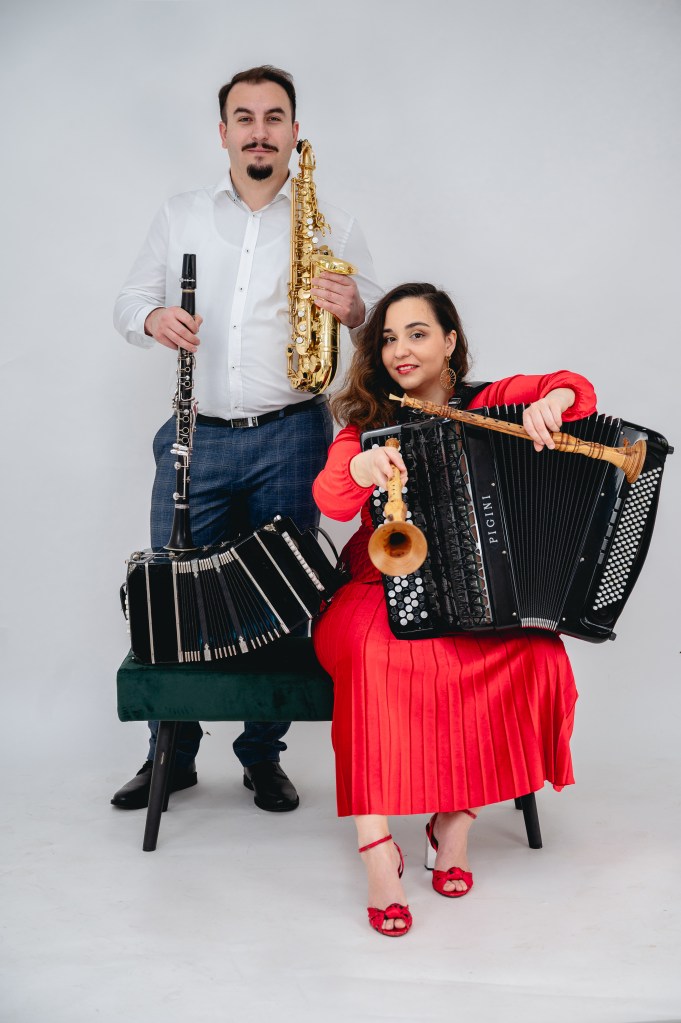
The Shape of Sound presents a chamber music program built on the direct physicality of tone production — where breath, bellows, and reed vibration transform into articulated musical form. Performed by Duo Croatico on clarinet, saxophone, accordion, and bandoneon, the program explores how sound is shaped — technically and expressively — in a dialogue between air, mechanics, and phrasing.
Each work on the program offers a different kind of musical “shape”: the precision of a classical variation (Weber), the lyrical arc of a miniature (Pejačević, Pierné), the rhythmic vitality of folk-rooted material (Falla), or the structural clarity of an étude (Donizetti, Piazzolla).
While the accordion and bandoneon produce tone through metal reeds activated by bellows, and the clarinet and saxophone through wooden reeds activated by breath, the common ground lies not only in their construction, but in their shared capacity to sculpt line, articulation, and texture in real time.
The result is not simply an unusual instrumentation, but a program that foregrounds the act of sound-making itself — and how compositional structure and performer technique shape musical narrative.
Duo Croatico, founded in 2023 by Martina Jembrišak (accordion, bandoneon) and Valentin Šeremet (clarinet, saxophone), explores the intersection of classical, contemporary, and traditional music through a distinctive instrumentation. Their programs reflect artistic versatility, cultural roots, and a deep interest in expanding repertoire and audience perception of reed instruments — both free-reed and single-reed.
Through inventive programming and original arrangements, the duo brings new life to chamber works across eras, while actively commissioning new compositions. Their performances have been praised for their expressive richness, technical fluency, and imaginative sound world.
DUO ARTINA
THE TRAVELLING FLUTE
The Travelling Flute is built around a rare gem in the contemporary Croatian repertoire — Alfi Kabiljo’s suite of the same name, composed as a series of musical snapshots inspired by cities that marked the composer’s artistic life. Kabiljo, known internationally for his work in theatre, film, and classical music, turns his reflections into character-rich miniatures that move from the nostalgic charm of My Beloved Zagreb to the rhythmic tension of Buenos Aires and the lyrical flair of Shanghai and Paris.
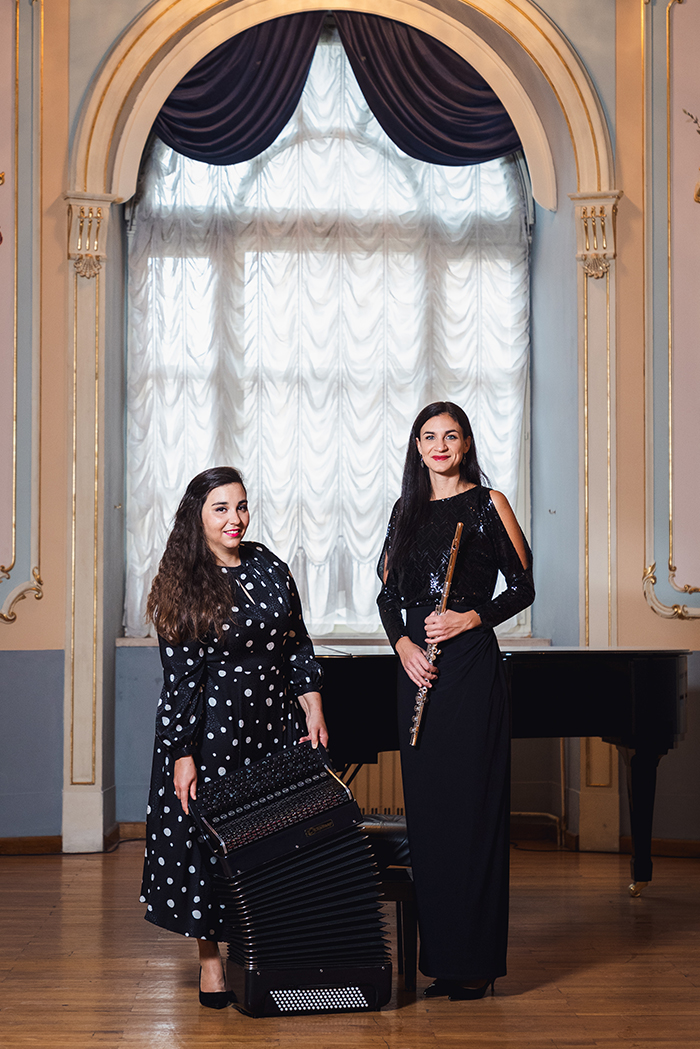
Inspired by this work, Duo Artina curates a concert that expands the idea of travel into a conversation between cultures, idioms, and personal histories — all shaped through the dialogue between flute and accordion. The program draws together composers whose works carry distinct national and individual imprints, each contributing to a shared soundscape of transformation and movement.
The lyricism of Franjo Krežma’s Noć na Savi (Night on the Sava) brings a moment of poetic stillness, while Ante Grgin’s Little Story transforms a private childhood melody into a work of refined concert intimacy. From China, the impressionistic Spring Tide by Li Xijin and He Dianxing carries the natural rhythm of water into a new instrumental dimension.
Frédéric Chopin’s early Variations appear in a fresh light through this unique instrumentation, offering a classical anchor to a program otherwise filled with lesser-known treasures. Finally, Eugène Damaré’s Le Merle Blanc allows the piccolo to sparkle in a virtuosic encore — light, dazzling, and joyous.
Together, these works do not simply “travel” — they translate. From language into sound, from experience into structure, from heritage into performance. The Travelling Flute is not a geographical itinerary, but a subtle interplay of memory, invention, and musical identity — brought to life through the intimate and dynamic pairing of two breath-based instruments that, in their shared sensitivity and coloristic range, create a world far larger than the sum of their parts.
 Martina Jembrišak